

In short
Sometimes at the end of a hard working day we may experience complaints such as swelling, heaviness and fatigue in the legs. Besides varicose veins, these can also be signs of a number of other conditions (heart failure, many kidney diseases, and diseases of the lymphatic system). For this reason…
Sometimes at the end of a hard working day we may experience complaints such as swelling, heaviness and fatigue in the legs. Besides varicose veins, these can also be signs of a number of other conditions (heart failure, many kidney diseases, and diseases of the lymphatic system).
For this reason, we should pay special attention to several signs in order to distinguish varicose veins from these conditions.
Varicose veins of the legs, in which swelling may affect one or both legs, are characterized by swelling that appears mostly in the afternoon. Swelling due to varicose veins often forms below the knee and especially around the ankles. During examination, other symptoms of varicose veins, such as bluish discoloration visible on the skin surface, should also be identified.
People often accept the feeling of fatigue and heaviness in the legs in the evening as normal at the end of a working day. In fact, these important symptoms are the first signs of varicose veins and indicate that they are developing.
It is true that fatigue and heaviness in the legs can also occur in various musculoskeletal disorders and in impaired lymphatic drainage. However, the main difference between varicose veins and these conditions is that with varicose veins, swelling and fatigue decrease significantly when lying down.
Varicose veins present with bruising on the legs, a network of visible veins ("bulging veins"), and pain and heaviness in the legs. Blood stagnates in the dilated veins and their permeability increases. As a result, blood leaks into the surrounding tissues and bruises appear on the skin.
What is vessel dilation?
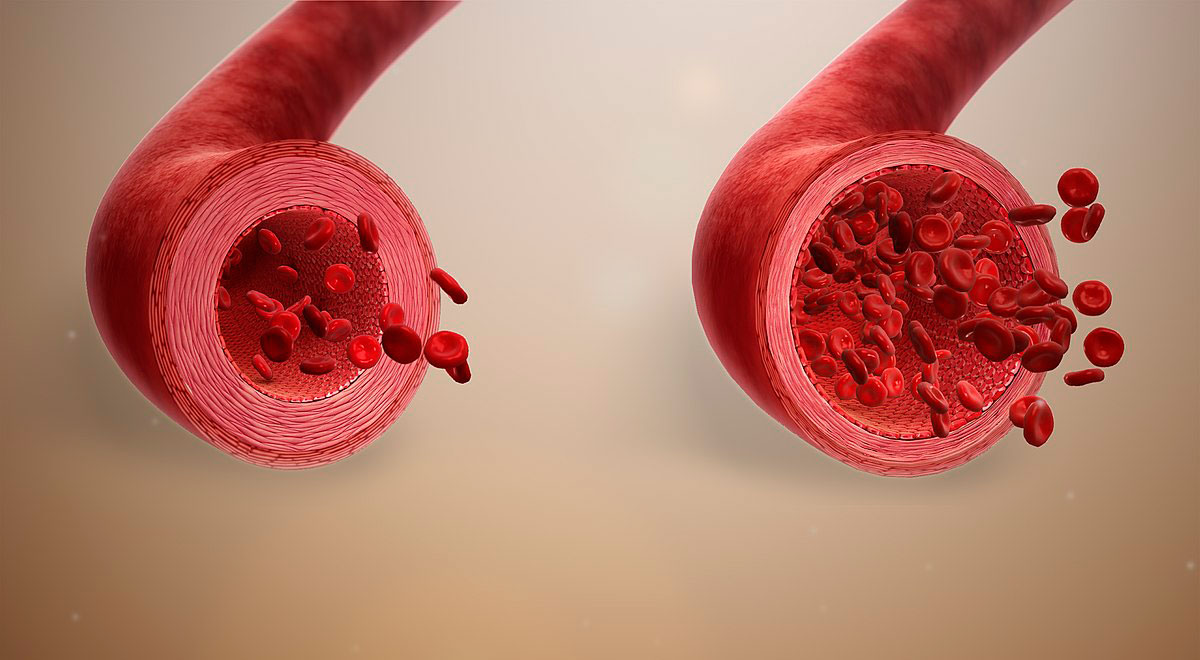
Vessel dilation is when a blood vessel grows wider than normal and its wall becomes weaker. It is most often found in the superficial veins of the legs (varicose veins), and less often as an aneurysm in large arteries such as the aorta. In veins it can cause blood to flow backwards, and in arteries it can cause the wall to thin. Only an examination can make an accurate diagnosis.
The two main forms differ considerably from each other. In venous dilation the problem is that the return of blood to the heart is disturbed: the small valves in the vein do not close properly and blood collects lower down. In arterial dilation (aneurysm), on the other hand, the wall, which is under high pressure, bulges out in one place. This difference directly affects the choice of tests and treatment.
The difference between venous and arterial dilation
| Criterion | Venous dilation (varicose veins) | Arterial dilation (aneurysm) |
|---|---|---|
| Location | Mostly the superficial veins of the legs | The aorta, brain, leg and other arteries |
| Main mechanism | Valve failure, pooling of blood | Weakening of the wall under high pressure |
| Appearance | Bulging vessels under the skin | Often not visible from the outside |
| Main danger | Swelling, ulcers, thrombophlebitis | Rupture or splitting of the wall (dissection) |
Causes and risk factors
Vessel dilation often arises from several factors acting together. For the venous form, sources such as the NHS and Mayo Clinic list the following risk factors:
- an inherited tendency and varicose veins in the family;
- reduced elasticity of the vessel wall with age;
- pregnancy and hormonal changes;
- excess weight;
- standing for long periods or a sedentary job;
- a previous history of thrombosis in the veins.
In arterial dilation, high blood pressure, smoking, atherosclerosis of the vessel wall and some inherited connective tissue diseases are considered the main risk factors. Having these factors does not mean the disease will definitely develop, but it does increase the need for testing.
Who should be tested?
People with vascular disease in the family, those who have worked on their feet for many years, women who have been pregnant, smokers and people with high blood pressure can consult a doctor even if they have no symptoms. For older men and those with a history of smoking, it is worth asking the doctor about an ultrasound check of the abdominal aorta.
Symptoms of vessel dilation
The symptoms depend on where the dilation is. In the leg veins the most common are:
- bulging, twisted, bluish veins under the skin;
- a feeling of heaviness, burning or throbbing in the legs;
- swelling of the calves and ankles in the evening;
- cramps at night;
- darkening, dryness and itching of the skin.
Dilation of the abdominal aorta often causes no symptoms for a long time and is found by chance during an ultrasound. Sometimes there may be a feeling of pulsation in the abdomen or pain spreading from the abdomen to the lower back. The absence of symptoms does not mean the situation is safe, so a planned check is important for people in risk groups.
When are leg symptoms caused by the blood vessels?
If the feeling of heaviness in the legs increases during the day and decreases at night when the legs are raised, this may point to venous insufficiency. Pain that appears when walking and passes with rest, on the other hand, may be related to narrowing of the arteries. In both cases a medical examination is needed to determine the cause.
Which tests are carried out?
The examination begins with the doctor listening to your symptoms and looking at the vessels. Then, depending on the situation, the following methods are used:
- Duplex ultrasound: shows the structure of the vessel, how the valves are working and the direction of blood flow. It is the main test in venous dilation.
- Computed tomography (angiography): clarifies the size and location of dilation in the large arteries.
- Magnetic resonance angiography: an alternative imaging method in selected cases.
- Laboratory tests: may be needed to assess blood clotting and general condition.
The doctor decides which test is needed; not all of them have to be done in every patient. Guidance on leg veins can also be found in the NICE guideline.
Treatment options compared
The aim of treatment is to relieve symptoms, prevent complications and improve the function of the vessel. The choice depends on the type and size of the dilation and the patient's general health. The table below is for general information and does not replace an individual decision.
| Method | What it is used for | Key feature |
|---|---|---|
| Conservative measures (compression stockings, activity, weight control) | Mild venous symptoms, when surgery is contraindicated | Relieves symptoms but does not return the vessel to its previous state |
| Sclerotherapy | Small and medium veins, spider veins | A special substance is injected into the vein and the vein closes |
| Laser or radiofrequency ablation | Large superficial veins with faulty valves | Minimally invasive; the vein is closed from the inside |
| Surgery | Extensive or complicated venous dilation | Removal or tying off of the damaged vein |
| Open surgical or endovascular (stent-graft) treatment of an aneurysm | An arterial aneurysm whose size or rate of growth poses a risk | The vessel wall is reinforced with a prosthesis |
For information about modern approaches and the choice of procedure, you can consult a cardiovascular surgeon. For small arterial dilations, monitoring the size at set intervals is sometimes chosen instead of an immediate procedure.
What does conservative treatment involve?
Compression stockings apply pressure to the leg veins from the outside and help blood flow upwards. The degree of compression should be chosen by the doctor, because in patients with weakened arteries an incorrectly chosen stocking can cause harm. Daily walking, raising the legs regularly and losing excess weight are also part of this group.
Possible risks and complications
Venous dilation that is not treated can, over time, lead to the following conditions:
- persistent swelling and darkening of the skin;
- inflammation of the superficial veins (thrombophlebitis);
- ulcers forming in the skin, especially around the ankle;
- formation of a clot inside the vessel.
The main risk of an arterial aneurysm is rupture of the vessel wall or separation of its inner layer; this is a life-threatening situation. The NHS provides extensive information about abdominal aortic aneurysm.
The treatment methods also have their own risks: bruising, numbness, infection, blood clots or recurrent dilation. The doctor should explain these risks in relation to the patient's condition.
Recovery and follow-up
Recovery varies with the type of treatment. After minimally invasive procedures, patients often return to daily activities within a short time, whereas recovery after open surgery can take longer. The treating doctor will tell you the exact time and any restrictions.
General recommendations are:
- wear compression stockings for the period your doctor prescribes;
- walk every day and raise your legs when resting;
- avoid standing still for long periods;
- keep your weight, blood pressure and smoking under control;
- have your planned follow-up ultrasound.
Regular follow-up helps detect new dilations in time. The frequency of follow-up tests is set by the doctor according to the type and size of the dilation.
Questions to ask your doctor
Going to the appointment prepared makes the conversation more useful. You can ask the following questions:
- What type of dilation do I have, and how large is it?
- Is treatment definitely needed, or is monitoring possible?
- Which methods suit my situation, and how do they differ?
- What are the risks of the procedure and the recovery time?
- When should the follow-up test be repeated?
- What should I avoid in daily life?
- Do the medicines I am currently taking affect the treatment?
Writing down when your symptoms started, in what situations they get worse, whether there is vascular disease in your family and a list of the medicines you take, and bringing this to the appointment, makes the doctor's work easier.
When should you call an ambulance (103)?
In the following situations call 103 (the ambulance number in Azerbaijan) without waiting:
- sudden, severe pain in the abdomen, lower back or chest;
- loss of consciousness, dizziness and cold sweat;
- sudden swelling, redness and pain in one leg (suspected clot);
- shortness of breath or chest pain;
- bleeding from a dilated vein that does not stop.
If there is bleeding, press on the wound with a clean cloth and raise the leg. These signs do not call for waiting for a planned appointment.
Information on this site is general and does not replace an examination by a doctor.