

In short
The Bentall procedure is an operation to replace a dilated aortic root together with the aortic valve. An aortic aneurysm may develop together with aortic valve regurgitation, or severe aortic valve stenosis may eventually cause the aortic root to dilate as well. The aortic root also contains the…
The Bentall procedure is an operation to replace a dilated aortic root together with the aortic valve. An aortic aneurysm may develop together with aortic valve regurgitation, or severe aortic valve stenosis may eventually cause the aortic root to dilate as well.
The aortic root also contains the aortic valve and the arteries that supply the heart, the coronary arteries. These can also become dilated.
In other words, regardless of the cause, a dilated aortic root is replaced together with the valve using the Bentall procedure.
The most dangerous and serious complications of aortic dilation are rupture of the vessel or a tear in its inner wall (dissection). For this reason, an ascending aorta that reaches a certain diameter must be replaced surgically.
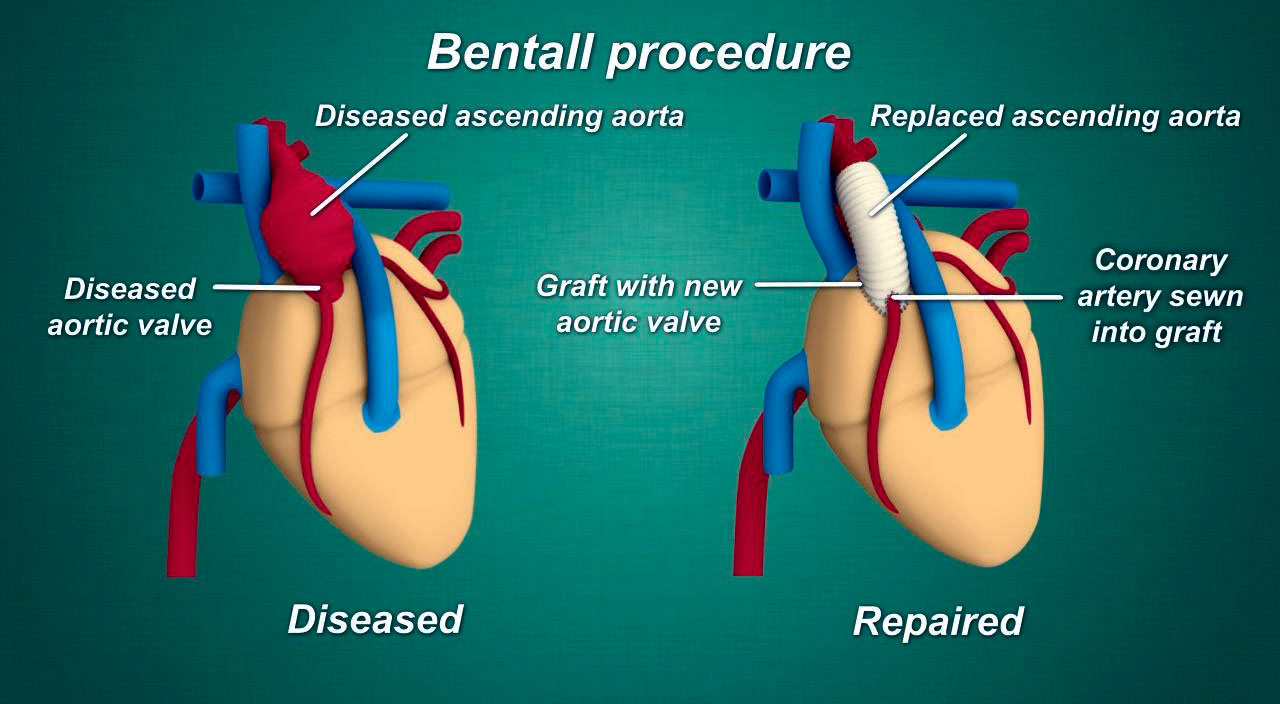
During the operation, the aortic valve is replaced with either a biological or a metal (mechanical) valve, and then the entire dilated aorta, including the aortic root, is replaced with a ready-made synthetic graft.
You should know that surgery is unavoidable when the diameter of the dilated aorta exceeds 55 mm. In suitable patients, the operation can also be performed minimally invasively through a small incision without fully dividing the breastbone.
The Bentall procedure is an open-heart operation in which the aortic valve and the aortic root above it (the beginning of the ascending aorta) are removed at the same time and replaced with an artificial vessel tube that contains a valve. The coronary arteries are reattached to the new vessel. The operation is chosen when aortic valve disease and widening of the aortic root occur together and repairing the valve and the vessel separately is not enough.
What is the Bentall procedure?
The aorta is the main blood vessel leaving the left ventricle of the heart. The part where it joins the heart is called the aortic root, and it includes the aortic valve and the openings of the coronary arteries. When this area is diseased all at once, for example when valve regurgitation and widening of the vessel occur together, a ready-made artificial vessel with a valve, called a composite graft, is used.
During the operation, the patient is connected to a heart-lung machine, the diseased aortic root and valve are removed, the composite graft is sewn in, and then the coronary arteries that supply the heart with blood are reattached to the graft. In some cases there are other, valve-sparing methods; these are compared below.
When is the operation needed?
The decision is not based on a single measurement, but on the condition of the valve, the size of the aorta, its growth rate, the patient's age, general health and symptoms taken together. International recommendations (for example, those of the European Society of Cardiology (ESC) and the American Heart Association) set certain threshold values for aortic size; the specific threshold is assessed individually for each patient by the surgeon.
Main indications
- Aortic root aneurysm together with aortic valve disease (regurgitation or narrowing).
- Widening of the aortic root associated with inherited connective tissue disorders (for example, Marfan syndrome).
- Widening of the aortic root in the setting of a bicuspid aortic valve.
- Splitting of the layers of the aortic wall (dissection) or infective endocarditis that has also damaged the valve.
- Complications involving the aortic root that develop after a previous operation.
Which symptoms need attention?
Widening of the aortic root can develop for a long time without causing any complaints and is often found by chance during echocardiography or a CT scan. With valve disease, the following complaints may occur:
- Shortness of breath and getting tired quickly during physical exertion;
- Heaviness or squeezing pain in the chest;
- Awareness of the heartbeat (palpitations), dizziness, fainting;
- Swelling of the legs.
These symptoms are also typical of other heart conditions, so the exact cause can only be established by examination.
What tests are done before the operation?
- Echocardiography: shows the structure of the valve, blood flow and the size of the aortic root.
- ECG: assesses heart rhythm and signs of strain.
- Computed tomography or magnetic resonance imaging: allows the entire length of the aorta to be measured accurately.
- Coronary angiography: checks the condition of the coronary arteries; if necessary, bypass grafting can also be added in the same operation.
- Blood tests and checks of other organs: carried out to assess readiness for surgery and the risk.
Surgical methods and choice of valve
There are several approaches to aortic root surgery. The choice depends on the patient's age, the condition of the valve, whether the patient can take blood-thinning medicines and their lifestyle.
Comparison table
| Method | What it involves | Advantage | Point to consider |
|---|---|---|---|
| Bentall (composite graft with a mechanical valve) | A mechanical valve and an artificial vessel are sewn in together | Long lifespan of the valve | Blood thinners are usually taken permanently |
| Bentall (composite graft with a biological valve) | A biological valve and an artificial vessel are used together | The need for blood thinners is often limited | The valve may wear out over time; a repeat intervention is possible |
| Valve-sparing aortic root surgery | The patient's own valve is kept and only the aortic root is replaced | No artificial valve is implanted | Only possible in selected patients whose valve is healthy |
| Separate valve and separate vessel replacement | The valve and the ascending aorta are replaced separately | Reattachment of the coronary arteries may not be required | Chosen in some anatomical situations |
The choice of valve type should be discussed openly with the patient. General information on the differences between mechanical and biological valves can also be found in reputable sources such as Mayo Clinic.
Risks of the Bentall procedure
As with any open-heart surgery, there are risks. Their level varies from patient to patient and should be explained individually before the operation. The main risks are:
- Bleeding or the need for a repeat operation;
- Rhythm disorders (including heart block and atrial fibrillation);
- Infection, including infection of the artificial material;
- Stroke or complications from blood clots;
- Temporary impairment of kidney and lung function;
- With a mechanical valve, the risk of bleeding or clotting while on blood-thinning medicines.
For exact risk percentages, rely only on reliable clinical sources and the surgeon's assessment specific to the patient; general figures do not promise an outcome for an individual patient. For more information, you can also look at the NHS pages.
Recovery and long-term follow-up
After the operation, the patient is monitored first in the intensive care unit and then on the ward. For the breastbone to heal, you need to avoid lifting heavy loads for a certain period and follow your doctor's instructions on driving and physical activity. Gradually increasing walking and a rehabilitation programme support recovery.
- Take your medicines as prescribed by your doctor; with a mechanical valve, have your blood clotting level (INR) checked regularly.
- Regular echocardiography and medical check-ups; monitoring of the rest of the aorta with tomography scans.
- Before dental procedures, consult your doctor about endocarditis prevention.
- Stopping smoking, blood pressure control and a balanced diet.
In people with an inherited connective tissue disorder, examination of family members may also be recommended.
Questions to ask your doctor
- In my situation, should the aortic valve and root be replaced together, or is a valve-sparing option possible?
- What advantages and limitations do mechanical and biological valves have for my age and lifestyle?
- Might coronary bypass grafting or another additional procedure be needed during the operation?
- Which medicines will I take after the operation, and for how long?
- How often will follow-up tests be carried out?
- Do my family members need to be examined?
When should you call emergency services (103)?
The following signs require immediate medical help; do not wait, call 103 (the ambulance number in Azerbaijan):
- Sudden, very severe, tearing pain in the chest or between the shoulder blades;
- Fainting;
- Sudden severe shortness of breath;
- Sudden speech disturbance, numbness of the face or an arm;
- After the operation, a high temperature, pus discharging from the wound or a feeling of movement in the breastbone.
Information on this site is general and does not replace an examination by a doctor.