

In short
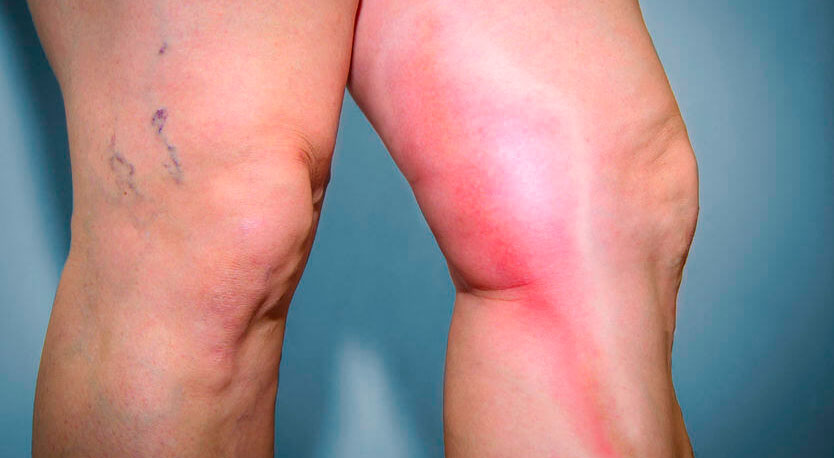
Thrombophlebitis, an inflammatory disease of the veins, is characterized by the formation of a thrombus inside the vein and is considered a serious complication of varicose veins of the legs. In this condition, the vein wall becomes inflamed and a thrombus (blood clot) forms in the lumen of the…
Thrombophlebitis, an inflammatory disease of the veins, is characterized by the formation of a thrombus inside the vein and is considered a serious complication of varicose veins of the legs. In this condition, the vein wall becomes inflamed and a thrombus (blood clot) forms in the lumen of the vein.
Symptoms:
- difficulty moving
- sharp pain along the vein containing the clot
- redness and hardening of the skin on the affected leg
- raised body temperature (low-grade fever up to 37.5–38 °C)
Causes:
- injuries
- obesity
- hereditary factors
- hormonal imbalance
- infectious diseases
- dehydration
- slowed blood flow
- atherosclerosis of the leg vessels
- intravenous medications
- varicose veins of the legs
If left untreated, a serious complication of varicose veins and thrombophlebitis develops – a trophic ulcer.
Thrombophlebitis that is not treated in time or treated improperly can lead to thromboembolism. Thromboembolism is a very serious condition. A clot inside a vein can travel with the bloodstream and lodge in other vessels and internal organs. When a clot reaches the pulmonary arteries, it blocks the artery (this is called "thromboembolism"), resulting in severe circulatory and respiratory failure and possibly the death of the patient.
Thrombophlebitis can be treated conservatively (with medication) or surgically. In severe cases, surgical treatment is used.
What is thrombophlebitis?
Thrombophlebitis is inflammation of the wall of a vein together with the formation of a blood clot (thrombus) inside that vein. It is most often found in the superficial veins of the legs, where the vein can be felt under the skin as a hard, painful, reddened cord. Forms that occur in the deep veins are considered more serious and require an immediate medical examination.
The difference between the superficial and deep forms completely changes the treatment approach. Because superficial veins are close to the skin, the signs are visible and can be felt by touch. Deep veins, on the other hand, lie within the muscle layer, so swelling, heaviness and general tension in the leg come to the fore. Both forms can also occur together in the same leg.
Who should be careful?
In the following situations it is advisable to have the venous system checked from time to time:
- people with varicose veins, especially if the veins have become hard and painful;
- people on prolonged bed rest or in the period after surgery;
- people who sit still for hours on long journeys or during the working day;
- patients who have an intravenous catheter in a vein;
- women during pregnancy and the period after childbirth;
- people with a family history of clotting disorders or venous thrombosis.
If you suspect a problem, it is not right to put heat on the painful area or massage it on your own. You need to be examined first.
Which tests are carried out for thrombophlebitis?
The main aim of testing is to determine the location of the inflamed vein, the length of the clot and how close it is to a deep vein. The doctor first listens to your symptoms, examines the leg and asks about risk factors. The following methods are then used.
Duplex ultrasound
This is the most commonly used test. It is painless and needs no special preparation. The ultrasound shows whether there is a clot inside the vein, how blood is flowing, and whether a clot in a superficial vein is extending towards a deep vein. If the clot is close to the deep system, the treatment plan must be built around this.
Laboratory tests
Blood clotting values (for example, D-dimer), inflammation markers and, if needed, additional tests for a tendency to clot may be ordered. The tests alone do not make the diagnosis; they are assessed together with the ultrasound result. In recurring cases with no clear cause, a broader investigation may be needed.
What happens at the appointment?
Patients often want to know what to expect at the appointment. At a cardiovascular surgeon's appointment the process usually goes like this:
- Medical history: you are asked when the pain started, whether the swelling has increased, and whether you have recently had surgery, a journey, a catheter or an injury.
- Examination: hardness, redness and warmth along the course of the vein, and any difference in the size of the legs, are assessed.
- Duplex ultrasound: the veins of both legs are checked, because the problem may not be limited to one leg.
- Explanation of the result: the location and length of the clot and its relationship to the deep vein are shown, and the treatment plan is agreed.
- Follow-up plan: the timing of the repeat examination and the changes to expect are explained to the patient.
Bringing your previous test and ultrasound results, a list of the medicines you take and any surgical discharge summaries to the appointment saves the doctor time.
Treatment options for thrombophlebitis
Treatment is chosen according to the location and length of the clot and the patient's general condition. International guidelines, including the NICE guideline on venous thromboembolism, stress that the decision should be based on a risk assessment. The table below gives a general comparison of the main approaches; the doctor determines the specific choice.
| Method | When it is considered | Main aim | Note |
|---|---|---|---|
| Compression stockings and keeping active | Short-segment, mild superficial thrombophlebitis | To reduce pain and support blood flow | The correct size and compression class must be chosen |
| Topical and oral anti-inflammatory medicines | When there is pain and redness | To calm the inflammation and pain | The doctor sets the dose and duration |
| Blood-thinning (anticoagulant) treatment | A long-segment clot, closeness to a deep vein or high risk | To prevent the clot from growing and spreading | Requires observation and monitoring |
| Surgical or endovenous procedure | Recurrent or severe cases on a background of varicose veins | To remove the diseased vein or remove the clot | The decision to operate is assessed individually |
Risks and complications of thrombophlebitis
Although superficial thrombophlebitis often has a good course, the following risks can arise if it is left unmonitored:
- Progression to deep vein thrombosis: the clot can spread from a superficial vein to a deep vein. Detailed information on this is given on the NHS deep vein thrombosis page.
- Pulmonary embolism: part of the clot can break off and reach the lung arteries. This is a life-threatening condition.
- Infection: on the background of a catheter or injury, the inflammation can turn into a pus-forming process.
- Recurrence: if the cause is not removed, it can develop again in the same or another vein.
- Post-thrombotic changes: long-term swelling, darkening of the skin and a feeling of heaviness may remain.
The specific level of risk differs from patient to patient. Mayo Clinic also draws attention to these complications on the topic of thrombophlebitis.
Recovery and follow-up
The recovery time depends on the location of the clot and the type of treatment. In mild forms, pain and redness gradually decrease, but the hardness in the vein may remain for longer. This on its own is not a cause for concern, but worsening symptoms should be reported to the doctor.
Steps that help during recovery:
- Do not stop the medicines your doctor has prescribed before the end of the course.
- Wear the compression garment as recommended.
- Walk regularly during the day and do not stay sitting in the same position for long.
- When sitting, move your ankles and, where possible, raise your legs.
- Drink enough fluids and keep your weight under control.
- Have the repeat ultrasound on the scheduled date.
Patients taking anticoagulants should watch for signs of bleeding (blood in the urine, black stools, unexplained bruising) and see a doctor if these occur.
Questions to ask your doctor
Going to the appointment prepared helps the treatment to be planned correctly. Useful questions to ask:
- Is the clot in a superficial or a deep vein, and how close is it to a deep vein?
- Do I need blood-thinning treatment in my situation, and for how long?
- What caused this episode, and do I need treatment for varicose veins?
- Which activities should be restricted, and when can I return to sport?
- When should the repeat examination take place, and which signs mean I should not wait?
- What should I pay attention to if I am planning a long journey, a pregnancy or an operation?
When to seek emergency help (103)?
If any of the following signs appear, do not wait; call 103 (the ambulance number in Azerbaijan):
- sudden shortness of breath, sharp chest pain when breathing in;
- coughing up blood or bloodstained sputum;
- a fast heartbeat, dizziness or loss of consciousness;
- sudden and severe swelling of one leg, a change in colour, rapidly increasing pain;
- a high temperature and pus forming in the inflamed area.
Information on this site is general and does not replace an examination by a doctor.