

In short
Carotid artery blockage, which can also be called narrowing (stenosis), is caused by hardening or calcification of the arteries. It is most common in people over 50 and in those with diabetes, high blood pressure or who smoke. The carotid artery is the artery located on both sides of the neck that…
Carotid artery blockage, which can also be called narrowing (stenosis), is caused by hardening or calcification of the arteries. It is most common in people over 50 and in those with diabetes, high blood pressure or who smoke.
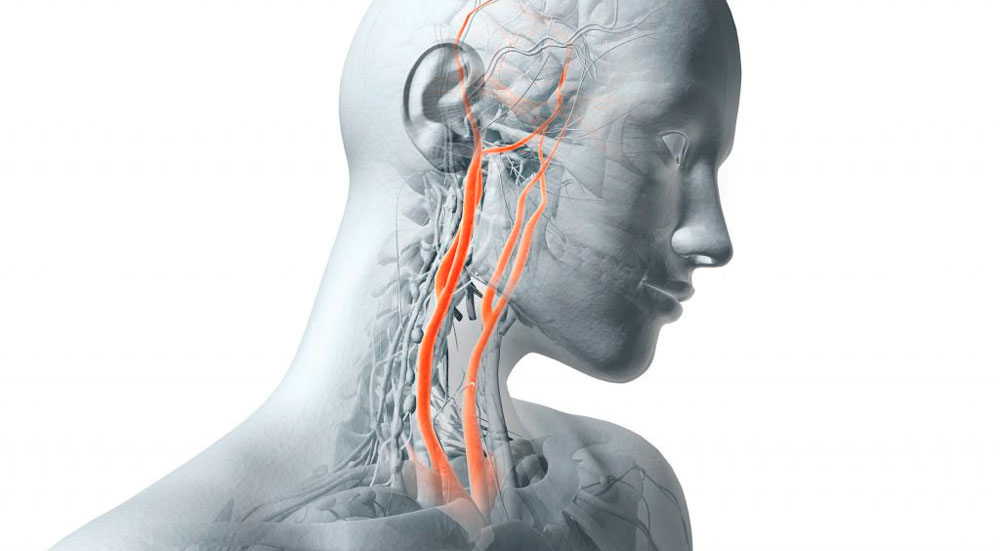
The carotid artery is the artery located on both sides of the neck that carries blood to the brain. The most important cause of blockage or narrowing of the carotid artery, which carries most of the blood the brain needs, is atherosclerosis.
If blood flow in the carotid artery drops to a critical level, the brain may not receive enough nourishment, which can ultimately lead to a stroke.
Also, when the artery narrows, a clot can travel to the brain, causing the following symptoms:
- Stroke affecting the arms and legs
- Brief episodes of blacked-out vision
- Numbness, tingling or weakness in the face or arm
- Speech disturbance, difficulty hearing or understanding speech
- Persistent dizziness before a clot travels to the brain
If the carotid artery narrowing exceeds 50%, the artery must be opened. Treatment consists of opening the narrowing surgically or by placing a stent. In milder cases, the problem can be managed with medication.
What is carotid artery stenosis?
Carotid artery stenosis is a narrowing, caused by atherosclerotic plaque, of the two main arteries in the neck that supply the brain with blood. The narrowing can reduce blood flow to the brain, or a fragment breaking off the plaque can block an artery in the brain and cause a stroke. Early detection and the right choice of treatment aim to reduce the risk of stroke.
There is one carotid artery on each side of the neck. Higher up, each divides into an internal and an external branch. The narrowing most often forms at this point of division, that is, at the start of the internal carotid artery. Blood flow in this area is turbulent and plaque builds up more easily. The degree of narrowing, whether the plaque is stable or vulnerable, and whether there are symptoms are the main factors that determine the treatment decision.
Plaque poses a danger in two ways. First, the artery gradually narrows so much that the brain does not get enough blood. Second, and more commonly, the surface of the plaque cracks, a clot forms on it, and a fragment that breaks off travels with the blood flow into a brain artery and blocks it. For this reason, even if the degree of narrowing is small, a vulnerable plaque can carry a serious risk.
Causes and risk factors
The main cause is atherosclerosis, that is, the build-up in the artery wall of plaque made up of cholesterol, calcium and inflammatory cells. This process progresses silently over years. The same mechanism also works in the heart arteries, so carotid narrowing is often regarded as an indicator of general vascular disease. To assess your situation, you can have a consultation with a cardiovascular surgeon.
Main risk factors
- high blood pressure;
- high "bad" cholesterol (LDL);
- smoking and use of tobacco products;
- diabetes;
- excess weight and an inactive lifestyle;
- age and a family history of early vascular disease;
- existing cardiovascular disease (ischaemic heart disease, atherosclerosis of the leg arteries).
Many of these risk factors can be changed. Keeping blood pressure, cholesterol and blood sugar under control slows the progression of plaque. The NHS carotid artery disease page and the corresponding Mayo Clinic section list the same risk factors.
When is treatment needed?
The decision is not based only on the question "how narrowed is the artery?". The doctor assesses several points together:
- Whether there are symptoms. In people who have had a transient ischaemic attack (TIA) or a minor stroke, the question of a procedure is discussed more seriously.
- The degree of narrowing. It is measured by ultrasound or tomography.
- The nature of the plaque. A vulnerable, ulcerated plaque is more dangerous in terms of the risk of fragments breaking off.
- General condition. Age, heart and kidney function, other conditions.
- The condition of the other side. Narrowing on both sides can change the approach.
For mild narrowings without symptoms, medicines and ongoing monitoring alone are often enough. The indication for a procedure, on the other hand, is determined by an individual decision and is based on the recommendations of bodies such as the European Society of Cardiology (ESC) and the American Heart Association (AHA). For example, the approach differs between a patient who has recently had a transient ischaemic attack on one side and has significant narrowing on that same side, and a patient with no symptoms at all in whom a mild narrowing was found by chance.
Diagnostic tests
The aim of testing is to clarify the location and degree of the narrowing and the nature of the plaque.
- Medical examination. Symptoms, any previous TIA or stroke, measuring blood pressure, listening for a vascular sound (bruit) over the neck. Blood pressure is measured in both arms.
- Doppler ultrasound of the neck arteries. Painless, radiation-free and the method of first choice. It shows the speed of blood flow and the narrowing, and also gives an idea of the structure of the plaque.
- CT angiography or MR angiography. Gives a more precise map of the artery and the brain arteries, and is important for planning surgery. Because a contrast agent is injected during CT, kidney function is checked beforehand.
- Laboratory tests. Lipid profile, blood sugar, kidney function.
- Heart examination. ECG, echocardiography. In people with carotid artery disease the heart arteries are also checked, because the condition of the heart needs to be known before surgery.
Treatment options
Medicines and lifestyle
The foundation of treatment is the same for all patients: medicines against blood clotting (antiplatelet medicines), cholesterol-lowering statins, and control of blood pressure and blood sugar. Stopping smoking completely, reducing salt, walking actively and bringing weight to a normal level are also part of this plan. Medicines must not be stopped without agreeing this with your doctor.
Endarterectomy
This is a surgical operation. A small incision is made in the neck, the carotid artery is opened and the plaque is removed together with the inner layer of the artery. The artery is then stitched or repaired with a patch. During the operation, special measures are taken to protect blood flow to the brain and the neurological condition is monitored. The operation can be a suitable choice especially for calcified, hard plaques.
Stenting
In this method, a catheter is inserted into an artery through a small puncture (usually in the groin) and a metal scaffold (stent) is opened at the narrowed site. A protective filter is used to stop fragments that break off from travelling to the brain. It is mostly considered in patients with a high surgical risk, those who have had radiotherapy to the neck, or those whose anatomy makes surgery difficult.
Comparison table
| Criterion | Medicines and monitoring | Endarterectomy | Stenting |
|---|---|---|---|
| What the method involves | Management of risk factors, medicines | Surgical removal of the plaque | Placement of a stent inside the artery |
| Incision | None | A small incision in the neck | Catheter access (usually the groin) |
| Anaesthesia | Not required | General or local | Often local |
| Who it may suit | Mild narrowing without symptoms | Patients with an indication whose anatomy is suitable for surgery | Patients with a high surgical risk or anatomical difficulties |
| Main risks | Side effects of medicines, progression of the narrowing | Stroke, bleeding, nerve damage, heart attack | Stroke, re-narrowing of the stent, bleeding at the access site |
Risks
Every procedure has risks. The most serious risk is a stroke or transient ischaemic attack during or after the operation. Other possible complications: bleeding or a haematoma in the neck, temporary damage to the nerves of the face and tongue (hoarseness, difficulty swallowing), a heart attack, and re-narrowing after a stent. Remaining untreated also has risks: a fragment breaking off the plaque can cause a stroke. This is why the decision is made by weighing risks against benefits. Results cannot be guaranteed, and the level of risk varies from patient to patient.
Recovery and follow-up
- After the operation the patient is monitored in hospital for a few days, and blood pressure and neurological condition are checked.
- There may be mild swelling and discomfort at the stitch site on the neck. Severe swelling, shortness of breath or any sudden new symptom should be reported to the doctor.
- Antiplatelet medicines and a statin are taken long term.
- Heavy lifting must be avoided for a certain period, and returning to driving is agreed with the doctor.
- Ultrasound of the artery is carried out at the prescribed frequency; this detects re-narrowing in the stent or at the operation site in good time.
- Stopping smoking, a low-salt diet rich in vegetables and regular walking are important for a lasting result.
You can read detailed information about stroke on the NHS stroke page and in the American Heart Association (AHA) stroke section.
Questions to ask your doctor
- How severe is the narrowing, and do I have any complaint that counts as a symptom in my situation?
- Are medicines and monitoring alone enough for now?
- Which is better for me, surgery or stenting, and why?
- What are the specific risks of each method for me?
- Which medicines should I take after the procedure, and for how long?
- When and how often will the next tests be carried out?
- What should I avoid in daily life?
When to seek emergency help (103)
The signs of a stroke start suddenly and every minute matters. If any of the following occur, call 103 (the ambulance number in Azerbaijan) without waiting:
- drooping of one side of the face, a lopsided smile;
- sudden weakness or numbness in one arm or leg;
- slurred speech, difficulty understanding what is said;
- sudden loss of vision or darkening in one eye;
- a sudden severe headache, dizziness, loss of balance.
Even if the signs pass after a few minutes, this may be a transient ischaemic attack, which signals a risk of a serious stroke in the following hours, so an ambulance should still be called. Do not drive yourself, and note the time the signs started.
Information on this site is general and does not replace an examination by a doctor.