
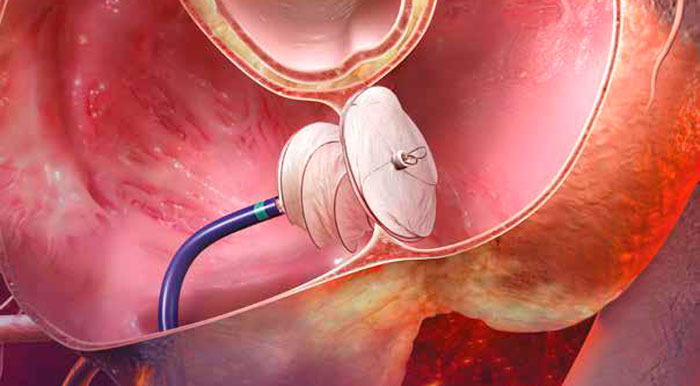
Atrial septal defect (ASD), a congenital heart anomaly, is characterized by an abnormal opening between the right and left atria.
Put more simply, ASD is a congenital heart defect in which the wall between the atria does not develop fully, leaving an opening in it. It accounts for about 7% of congenital heart defects (mainly in females).
Symptoms:
heart murmurs
a "cardiac hump" (chest wall bulge)
shortness of breath
tiring easily
palpitations
pale skin
delayed physical development
frequent recurrent respiratory infections
In this condition, the wall separating the right and left atria remains open, meaning there is a hole in the septum. Through this hole, oxygen-rich blood mixes with oxygen-poor blood. If the amount of blood passing through the defect exceeds a certain level, the defect must be closed. Otherwise, it may lead to complications such as heart failure in the future. If the structure of the defect allows, the hole can be closed without surgery (by a transcatheter approach).
For many years ASD was treated with open-heart surgery through a divided breastbone; today it is repaired surgically using a minimally invasive method through a 3–4 cm incision in the armpit. Because the breastbone is not cut, patients treated this way return to normal life very quickly after surgery.
Information on this site is general and does not replace an examination by a doctor.