
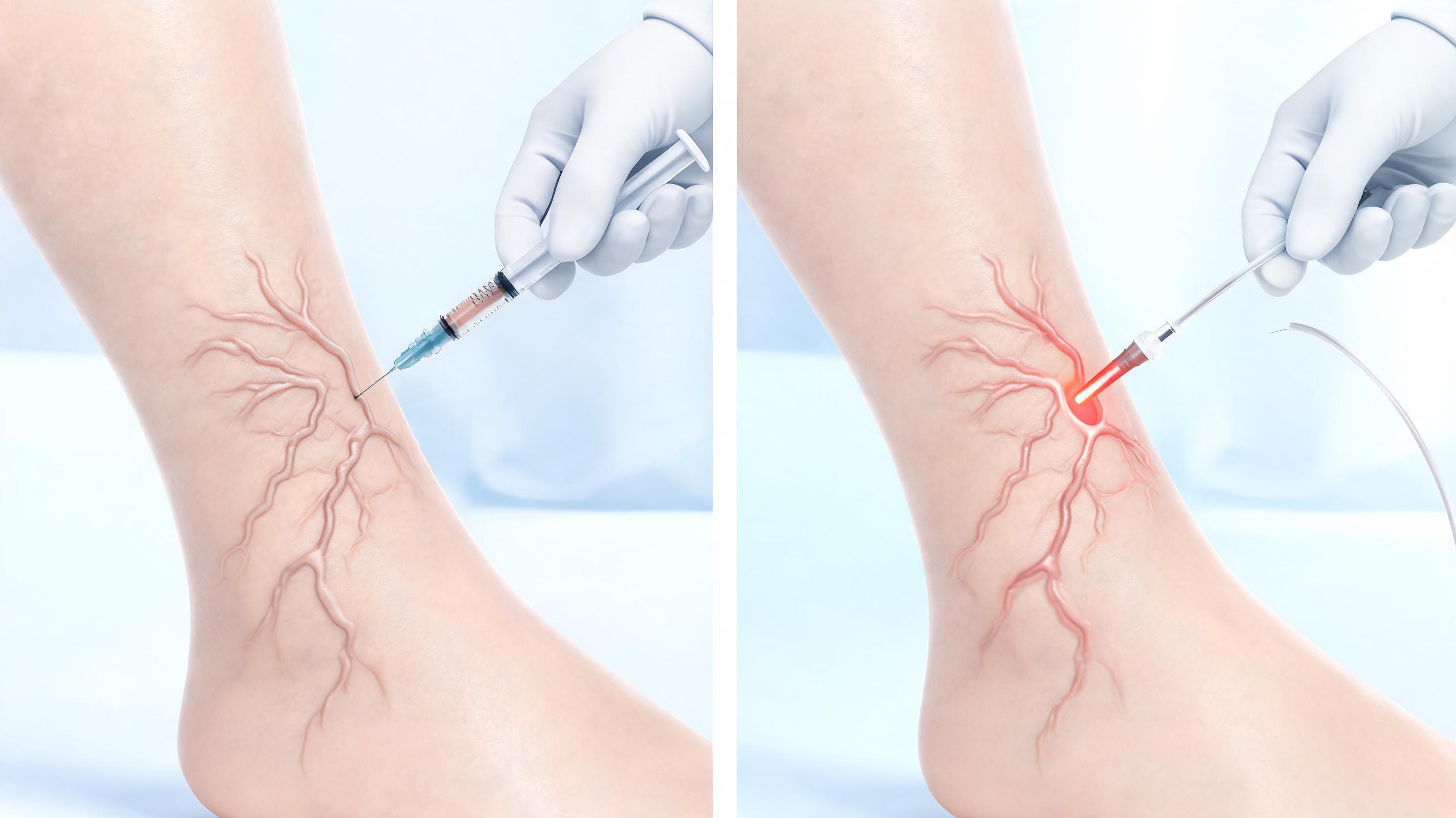
Sclerotherapy vs laser has no single answer: the choice depends on the size of the vein and where the valve insufficiency is located. Sclerotherapy is usually intended for small and medium veins and spider-web-like appearances, while laser (endovenous ablation) is intended for large trunk veins with valve insufficiency. Only a doctor can make the exact choice, after a Doppler examination.
What sclerotherapy is and how it is performed
In sclerotherapy, a special substance (a sclerosant) is injected into the dilated vein with a thin needle. The substance irritates the vein wall, the vein shrinks, is gradually absorbed by the tissue, and blood flow is redirected to healthy veins. The procedure is usually performed on an outpatient basis, does not require general anesthesia and does not take long. After the procedure, you may need to wear a compression stocking for the period your doctor recommends.
You can read more about this method on the sclerotherapy page.
Which veins it is suitable for
- spider-web-type capillaries visible under the skin (telangiectasias);
- small and medium-sized reticular veins;
- small branches coming off a large trunk vein;
- residual veins left after surgery.
What laser treatment for varicose veins is
Laser treatment for varicose veins is called endovenous laser ablation in medical terms. Under ultrasound guidance, a thin laser fiber is inserted into the dilated vein. The laser energy heats the inner wall of the vein, the vein closes, and it scars over and stops functioning. The vein does not need to be cut out from the outside, so it is a smaller intervention than traditional surgery. For more detail on the essence of the method, see our article on laser ablation and the material on painless varicose vein surgery.
When it is preferred
- if valve insufficiency of the great or small saphenous vein is confirmed by Doppler;
- if the vein diameter is too large for sclerotherapy;
- if heaviness, swelling and night cramps originate from the main trunk vein.
Sclerotherapy vs laser: comparison table
| Criterion | Sclerotherapy | Laser (endovenous ablation) |
|---|---|---|
| How it is performed | A sclerosant is injected into the vein with a needle | A laser fiber is inserted into the vein and heated under ultrasound guidance |
| Which veins it is for | Capillaries, small and medium veins, branches | Large trunk veins with valve insufficiency |
| Pain | Usually mild discomfort | Performed under local anesthesia, sensation is individual |
| Recovery | Short, usually a quick return to daily life | Short, but compression and activity recommendations must be followed |
| Chance of recurrence | Dilation may appear in new veins, and a repeat session may be needed | The treated vein is closed, but because the tendency to varicose veins remains, they may reappear in other veins |
| Examination requirement | Doppler is recommended | Doppler is mandatory |
The table is for general information. Every patient's vein anatomy is different, and results should not be taken as a guarantee.
Which method suits whom
The choice starts not with the question "which method is stronger?" but with "where is the source of the problem?" In practice, three typical situations are distinguished.
- Cosmetic complaint only. There are spider veins or small blue veins on the leg, and there is no blood flow disorder. In this case, sclerotherapy is usually discussed.
- Valve insufficiency in a trunk vein. There is heaviness in the legs, evening swelling, night cramps and bulging veins. If Doppler shows valve insufficiency, laser ablation is considered the main option.
- Mixed picture. If both the large trunk vein and its branches are affected, a staged approach may be used: first laser for the trunk vein, then sclerotherapy for the remaining branches.
In cases such as active thrombophlebitis, suspected deep vein thrombosis or severe skin changes, a different approach may be needed. That is why it is important to see a doctor before choosing the type of treatment yourself.
Why Doppler examination is important
The vein visible to the eye is often only the surface of the problem. Patients usually ask for treatment of the visible vein, but the real source of the complaint is often deeper, in a trunk vein whose valve is insufficient. A Doppler ultrasound of the leg veins shows the following:
- whether the vein valves work and whether blood flows backward;
- whether the problem starts in a large or a small vein;
- whether the deep veins are open;
- the vein diameter, that is, which method is technically possible.
If sclerotherapy is performed only on the visible veins without treating the source of valve insufficiency, the veins may tend to fill again. Conversely, a small cosmetic vein does not need a laser procedure. The UK's NICE varicose veins guideline (CG168) also lists ultrasound examination as a key step before the treatment decision.
From examination to treatment: the stages
- Listening to complaints. The doctor asks about heaviness, swelling, cramps, skin changes, family history of varicose veins and previous treatments.
- Physical examination. The legs are examined in a standing position, and the location and size of the veins are assessed.
- Doppler ultrasound. Valve insufficiency, reflux and the condition of the deep veins are checked.
- Planning. Sclerotherapy, laser, their combination, or for now only observation and compression are discussed.
- Treatment and follow-up. A planned follow-up examination is carried out after the procedure, and an additional session is scheduled if needed.
This sequence ensures that treatment serves a medical purpose, not only a "cosmetic" one.
Recovery after treatment and chance of recurrence
After both procedures, it is usually advised to keep walking, not to stay immobile for long periods, and to wear a compression stocking for the period your doctor recommends. A mild feeling of tightness, small bruises or temporary redness may occur, and these are usually transient. If signs such as fever, severe pain, swelling of one leg or shortness of breath appear, you must see a doctor immediately.
As for the chance of recurrence, varicose veins are linked to factors such as hereditary tendency, pregnancy, long periods of standing and excess weight. You can find information on the role of genetic factors in the genetic varicose veins article. Even if the treated vein stays closed, new dilation may appear in other veins. That is why planned follow-up after treatment, daily physical activity, weight management and, when needed, compression recommendations affect the long-term result. For general explanations, you can also look at the NHS varicose veins page.
Possible side effects and risks
Every medical intervention carries risks, and the patient should know about them in advance. After sclerotherapy, temporary darkening of the skin along the treated vein, small hard lumps, bruising or, rarely, an allergic reaction may be observed. After laser ablation, a feeling of tension in the treated area, bruising, a temporary change in sensation and, rarely, serious complications such as thrombosis may occur. To reduce these risks, the procedure should be performed under ultrasound guidance, by an experienced doctor and in accordance with individual indications. If any worrying sign appears, you should not wait.
Daily recommendations before and after the procedure
- inform your doctor in advance about the medicines you take, especially blood thinners;
- choose comfortable clothing and suitable shoes on the day of the procedure;
- take a light walk during the day after treatment and avoid sitting or standing for long periods;
- do not take off the compression stocking for the period your doctor recommends;
- postpone hot baths, saunas and heavy physical exertion until your doctor allows;
- drink enough fluids and keep your weight under control.
The article on vein health and water intake may also be useful for daily habits that improve circulation.
The most common misconceptions
- "Laser is always more modern, so it is better." What matters is not how modern the method is but how well it fits the type of vein. For a small vein, sclerotherapy may be more appropriate.
- "Sclerotherapy is only cosmetic." Although the cosmetic purpose is primary, in some cases small veins that cause complaints are also treated with this method.
- "Once I am treated, I will never have varicose veins again." Because the tendency to varicose veins remains, follow-up must continue.
- "Doppler is not needed, the vein is visible to the eye." The real source is often not visible to the eye, and only ultrasound shows it.
For reading about the general signs of vein problems, the Mayo Clinic's page on varicose veins is also a useful source.
Varicose vein treatment in Baku: when to see a doctor
If you have any of the following signs, it is advisable to be examined in time:
- persistent heaviness, tiredness and evening swelling in the legs;
- veins that look bulging and twisted;
- darkening or dryness of the skin around the ankle;
- a wound that does not heal, or a painful, reddened, hardened area over a vein.
The examination should be performed by a cardiovascular surgeon. The author, Dr. Cabir GÜLMALIYEV, works as a cardiovascular surgeon at Liv Bona Dea International Hospital in Baku. This article is for general information and does not replace an individual examination; the treatment method is determined only after a personal examination and the Doppler result.
Frequently asked questions
Can sclerotherapy and laser be used at the same time?
Yes, in some cases laser can be planned for the main trunk vein and sclerotherapy for the small branches that come off it. The doctor makes the decision based on the Doppler results.
Can varicose veins come back after treatment?
Varicose veins are a chronic tendency, and new veins other than the treated ones may become dilated. That is why medical follow-up and lifestyle recommendations are important.
Is sclerotherapy painful?
It is usually done with a thin needle, and most patients feel mild discomfort. Sensation varies from person to person.
When can I return to work after laser treatment?
Recovery time is individual and depends on the scope of the procedure. The treating doctor determines when you can return to daily activities.
Are these methods used in pregnant women?
During pregnancy, planned varicose vein treatment is usually postponed. You should consult a doctor for each individual case.
Which examination is needed before treatment?
A Doppler ultrasound of the leg veins shows the condition of the vein valves and the direction of blood flow, and it forms the basis for choosing the treatment.