
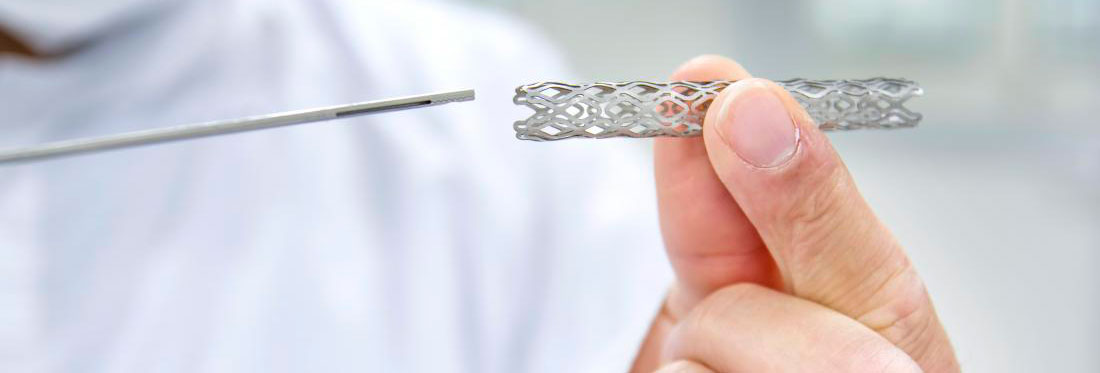
You should know that not every narrowed artery needs a stent!
Here we can take as an example the coronary arteries that supply our heart, which have a diameter of 2–4 mm. Side branches that gradually become thinner (i.e. smaller in diameter) come off these arteries. As a rule, stents should not be placed in vessels smaller than 2 mm in diameter that are found to be narrowed on angiography.
The reason is that stents placed in such thin vessels are very likely to become blocked within a few months. In addition, because these thin vessels supply only a small amount of heart tissue, their blockage does not cause a major problem. That is why medication is recommended instead of stenting for narrowed thin vessels.
Stents can be drug-eluting (popularly called "coated stents") or bare-metal. Drug-eluting stents are regular stents coated with special drugs that inhibit cell growth. These drugs reduce the likelihood of the stent becoming blocked or narrowed over the medium or long term. These stents are less likely to become blocked than regular (bare-metal) stents. That is why we mostly use drug-eluting stents to open narrowed coronary arteries.
Remember that once a narrowed coronary artery has been opened with a stent — whether drug-eluting or bare-metal — there is no guarantee that the stent will never become blocked again. Usually, if a stent does not become blocked within 1 year of placement, the likelihood of later blockage decreases. Even after the narrowed artery has been opened with a stent, patients need to take certain medications for life.
Information on this site is general and does not replace an examination by a doctor.